Professional Work

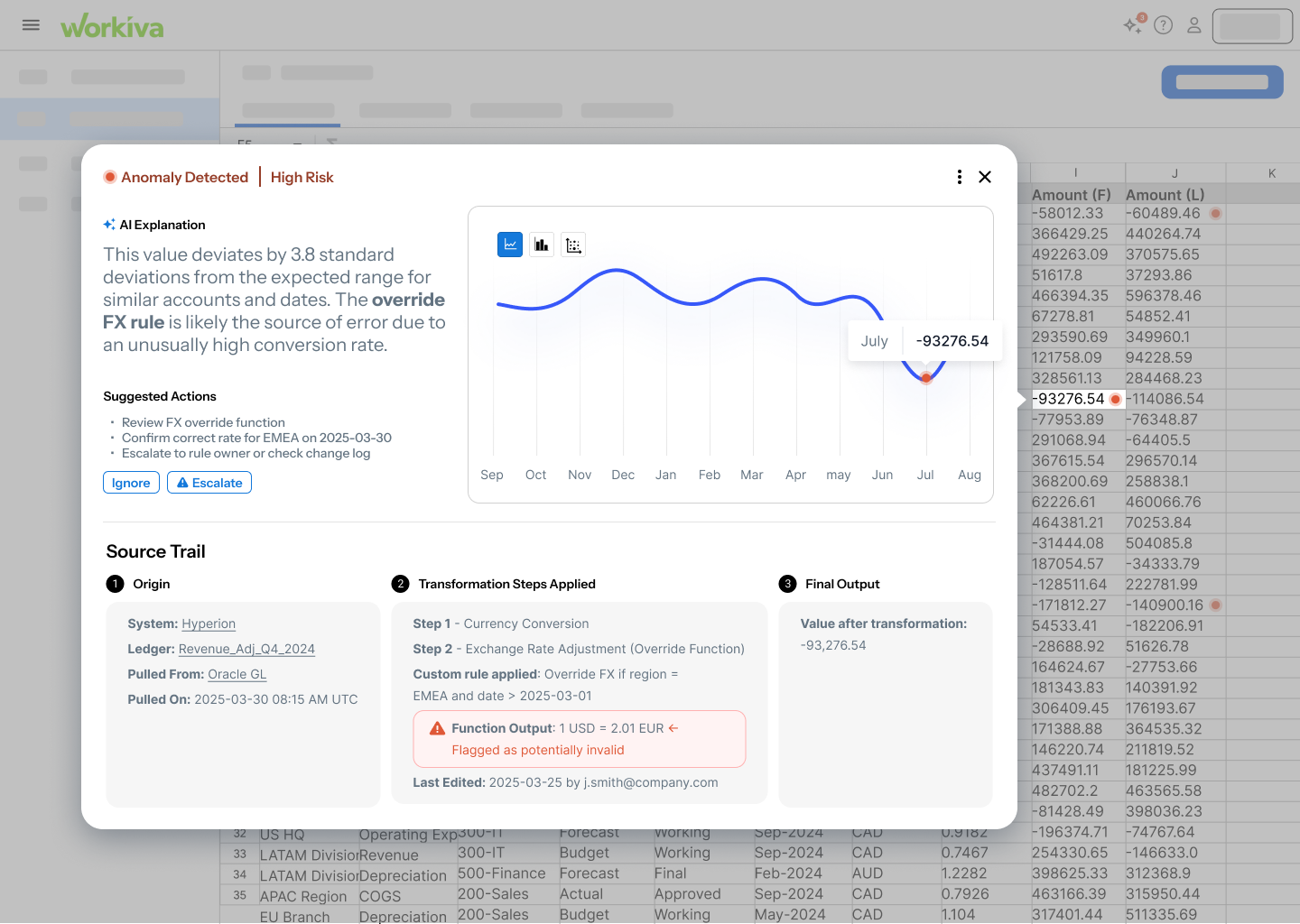
Spreadsheet Anomaly Detection interface showing contextual error details

Spreadsheet Anomaly Detection

AI-powered error detection that makes expert-level insights accessible to everyday spreadsheet users

UX Research & Design AI/ML Interface Graduate Project

As spreadsheets grow in complexity, spotting errors and unusual patterns becomes nearly impossible for non-experts. We designed an AI-powered solution that embeds contextual anomaly detection directly into users' existing workflows—transforming technical alerts into clear, actionable insights without requiring data science expertise.

Key Outcomes

  • Users confirmed the solution "makes it very obvious where you're supposed to look" with focused, contextual error explanations
  • Inline detection with progressive disclosure eliminated the need to switch between tools or screens
  • Customizable sensitivity settings addressed the critical insight that "a spike in one context might be noise in another"
Role UX Researcher & Designer
Timeline 10 weeks
Core Skills User Research, Prototyping, AI/UX
View Case Study →
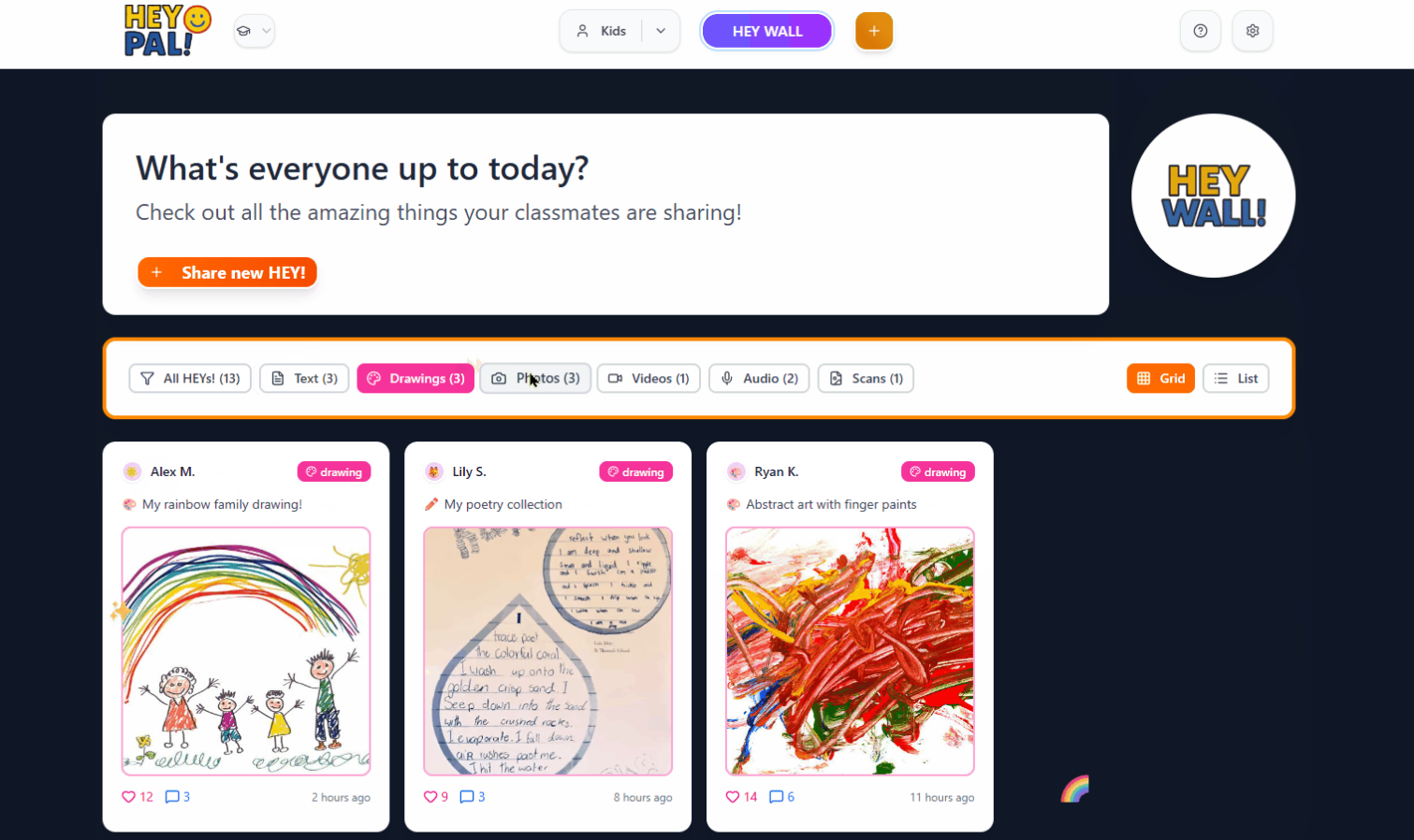
HEY PAL! collaborative learning platform interface

HEY PAL!

Educational platform co-designed with third-graders during pandemic lockdown

Co-Design EdTech Full-Stack Development

When the pandemic forced classrooms online overnight, existing tools weren't built for eight-year-olds—they required adult literacy, six different logins, and eliminated the spontaneous sharing that makes learning alive. I co-designed HEY PAL! with my third-graders, creating emoji-based visual login, gamified XP systems, and a shared "HEY WALL" that restored the magic of classroom community.

Impact

  • 27% increase in assignment completion rates
  • 8× increase in student participation on the shared wall
  • 6-7× increase in parent engagement with student work
Role Designer & Developer
Timeline 12 weeks
Core Skills Co-Design, UX, Development
View Case Study →
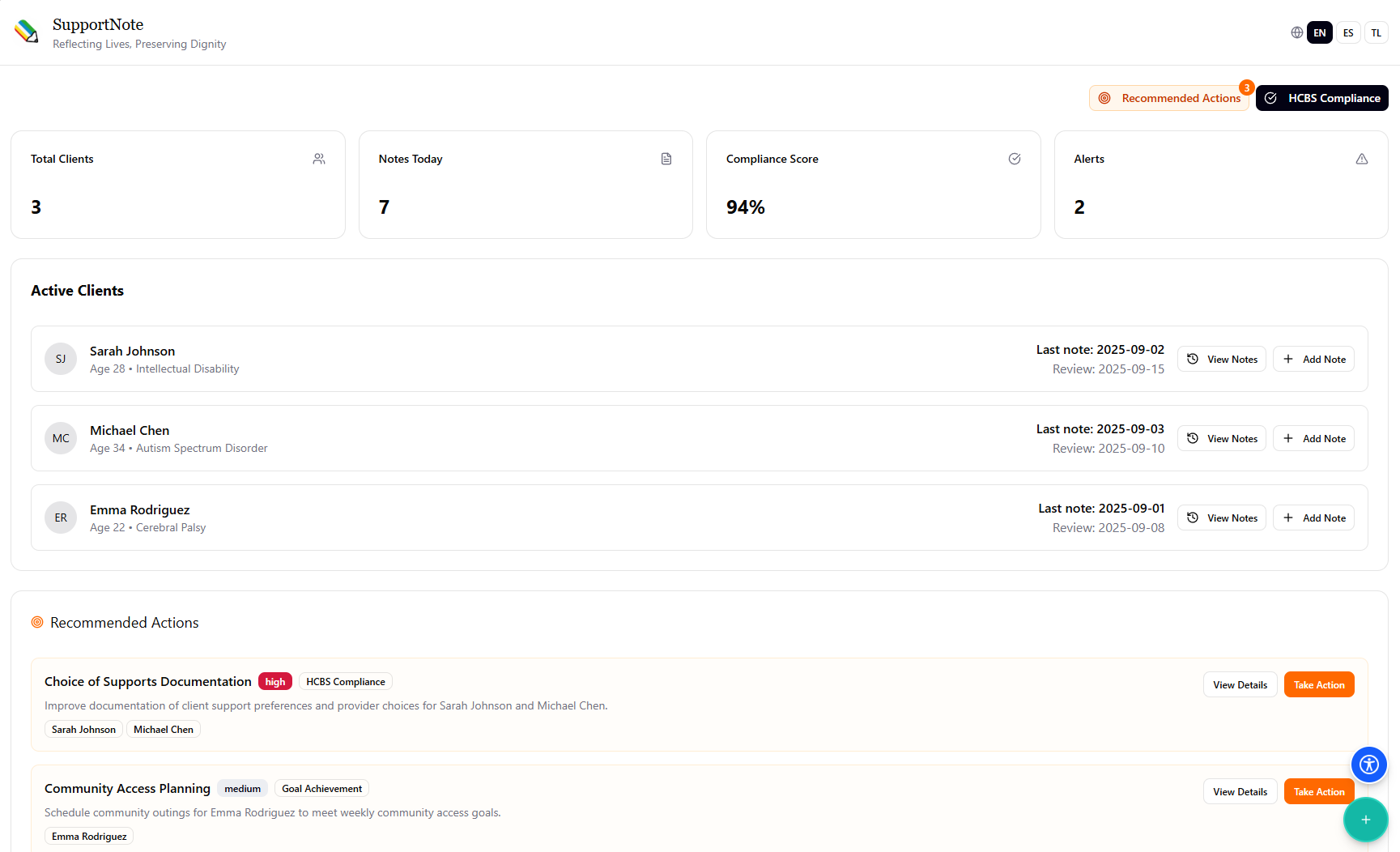
SupportNote documentation platform for disability support workers

SupportNote

Documentation platform transforming regulatory compliance into person-centered care

Product Design Lead Healthcare Tech Accessibility-First

Direct Support Professionals face 40%+ annual turnover, drowning in paperwork systems that weren't built for them—English-only forms for a multilingual workforce, deficit-focused language that dehumanizes the people they support, and compliance chaos across disconnected platforms. I designed SupportNote with dignity-first principles: voice-to-text in three languages, AI-assisted person-centered language, and invisible HCBS compliance scaffolding that makes doing the right thing the easy thing.

Impact

  • 40% reduction in documentation time for DSPs
  • Compliance audit readiness improved from 67% to 94%
  • First-time ability for DSPs to document in their primary language across English, Spanish, and Tagalog
Role Product Designer & Developer
Timeline 8 months
Core Skills Accessibility, Healthcare UX, Development
View Case Study →

Academic Projects

Sonic Sculptures in Space - A VR Synthesizer Experience
HCI5800: Virtual Environments, Virtual Worlds, and Applications
â–¼
Solo Project Full Semester VR Development Unity/C#
Problem: Traditional digital audio interfaces create high barriers to musical expression for non-musicians, operating in 2D and requiring substantial technical expertise.

Solution: Created an immersive VR environment that transforms sound design into an embodied, spatial practice. Users manipulate audio through physical interaction with 3D objects rather than abstract interfaces.
Key Outcomes:
  • Achieved 17.9/20 average score from industry judges (Innovation: 4.6/5, Technical Complexity: 4.4/5)
  • Developed real-time audio synthesis system with spatial 3D positioning
  • Implemented intuitive gesture-based controls for waveform manipulation
  • Created procedural musical harmony system using ScriptableObject architecture
Role: Project Manager, UX Designer, Unity Developer - responsible for all research, design, development, and testing

Methods: Unity XR Toolkit, C# scripting, real-time audio synthesis, spatial audio design, iterative prototyping

Skills Demonstrated: VR interaction design, real-time systems, accessibility-focused design, technical problem-solving, user-centered development

View Full Report →
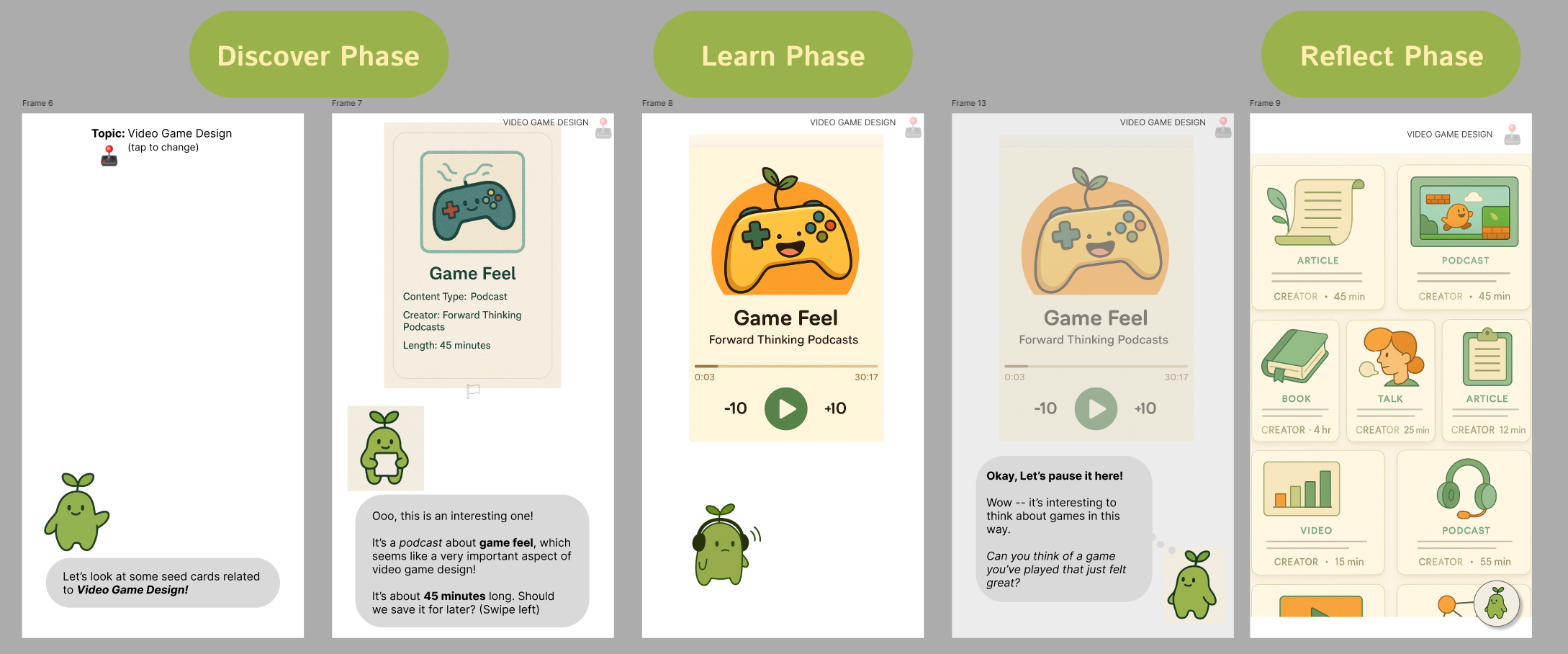
Scaffolding Autonomy: Designing for Trust and Learning in AI-Supported Autodidactic Environments
COMST 5900: AI/Robotics and Communication
â–¼
Scaffolding Autonomy research project
Solo Research Full Semester AI Ethics Educational Design
Problem: Current AI educational systems often fail to build trust and social presence with learners, particularly in self-directed learning environments where learner confidence and autonomy are crucial.

Solution: Developed a comprehensive theoretical framework combining self-efficacy theory, social presence theory, and aesthetic-usability effects to guide AI learning companion design. Created "Project Seedling" prototype concept that transforms abstract concepts into collectible knowledge artifacts.
Key Outcomes:
  • Achieved perfect score (200/200) with instructor praise for "most thoroughly researched idea"
  • Produced comprehensive literature review spanning HCI, educational psychology, and AI ethics
  • Designed mixed-methods research methodology for future empirical validation
  • Synthesized five theoretical frameworks into actionable design principles
Role: Sole researcher and author - conducted literature review, theoretical synthesis, prototype conceptualization, and research design

Methods: Systematic literature review, theoretical framework development, prototype design, experimental methodology design

Skills Demonstrated: Research synthesis, theoretical analysis, AI ethics, educational design, academic writing, interdisciplinary thinking

View Full Report →
Bridging Worlds: Connection, Culture, and Design in Immersive Language Learning
Group ethnography, HCI 5900: Design Ethnography
â–¼
Bridging Worlds ethnographic research
5-Person Team 20 Weeks Ethnographic Research Community-Engaged
Problem: Language learning technologies often fail to account for the cultural, emotional, and community contexts that are essential to authentic language acquisition for English language learners.

Solution: Conducted multi-sited ethnographic research across libraries, schools, and social centers to understand how contextual learning, human relationships, and cultural identity shape language learning experiences. Proposed "TalkTown Adventures" - a multiplayer game prototype for authentic conversation practice.
Key Outcomes:
  • Achieved perfect score (100/100) for comprehensive ethnographic study
  • Identified five key themes linking language learning to identity, community, and technology
  • Demonstrated how relational scaffolding builds learner confidence more than software
  • Designed game-based intervention honoring cultural complexity of language acquisition
Role: Lead researcher and project manager - conducted fieldwork, performed qualitative analysis and coding, wrote research paper, managed literature review, coordinated 5-person team

Methods: Multi-sited ethnography, participant observation, semi-structured interviews, artifact analysis, thematic coding, qualitative data analysis

Skills Demonstrated: Ethnographic research, qualitative analysis, project management, cultural sensitivity, community engagement, academic writing, team leadership

View Full Report →
Crafting Optimal Experience: A Mixed Methods Approach to Identifying Design Features that Evoke Flow State
DSN 501: Research Design
â–¼
Crafting Optimal Experience flow research
Solo Research Full Semester Mixed Methods Eye-tracking
Problem: While the concept of flow is central to positive gaming experiences, game designers lack a comprehensive, evidence-based framework for identifying which design elements most reliably evoke flow. Existing research emphasizes challenge-skill balance but does not fully integrate physiological, behavioral, and experiential data.

Solution: Conducted a mixed-methods study combining eye-tracking, psychophysiological measures, gameplay telemetry, and reflective interviews to identify the design features that most consistently induce flow. Synthesized findings into the CLEAR Framework (Challenge, Latency, Evolution, Audio, Readability) to guide developers in designing for optimal player engagement.
Key Outcomes:
  • Achieved perfect score (100/100) for rigorous mixed-methods research design
  • Identified measurable "flow profile" across physiological, behavioral, and experiential levels
  • Developed CLEAR Framework offering practical design guidance grounded in empirical evidence
  • Extended theoretical understanding of flow through progressive mastery and multisensory integration
Role: Principal researcher and author - conducted literature review, research design, experimental setup, data collection, statistical and thematic analysis, framework development

Methods: Mixed-methods research, eye-tracking (iMotion), psychophysiological monitoring (Shimmer3 GSR+), gameplay telemetry, stimulated recall interviews, thematic coding, statistical analysis in JMP

Skills Demonstrated: Research design, HCI theory integration, data triangulation, experimental methods, UX analysis, framework synthesis, advanced statistical analysis

View Full Report →
Design Thinking: Efficacy, Adoption, and Evolution
HCI Capstone Research Project
â–¼
Design Thinking research
Solo Capstone Full Semester Industry Analysis Academic Research
Research Question: How effective is design thinking as a methodology and competitive advantage in 2025? What productive tensions drive meaningful innovation in technology organizations?

Approach: Conducted comprehensive analysis synthesizing academic literature, industry case studies (Apple, Google, IBM), and peer-reviewed research on innovation outcomes. Developed theoretical framework identifying five productive tensions that shape effective design practice in complex organizational environments.
Key Findings:
  • Success requires contextual adaptation rather than generic framework implementation
  • Identified five productive tensions (reliability vs. validity, intuition vs. process, etc.) that drive breakthrough innovation when skillfully navigated
  • Competitive advantage lies in managing complexity thoughtfully, not standardizing processes
Role: Principal researcher and analyst - conducted literature review, industry case study analysis, theoretical framework development, and strategic implications synthesis

Methods: Mixed-methods research, industry case study analysis, academic literature synthesis, theoretical framework development, empirical data analysis, strategic assessment

Skills Demonstrated: Research synthesis, strategic analysis, theoretical framework development, industry trend analysis, translational research, academic writing, systems thinking

Industry Relevance: Demonstrates ability to translate between academic research and practical implementation - what Donald Norman calls "translational development." Framework provides strategic guidance for technology organizations implementing design thinking while maintaining space for creative innovation and contextual adaptation.

Instructor Feedback: "Really strong narrative and flow throughout the presentation. I really enjoyed your unique perspective on the evolution of design thinking, the key milestones and concepts that have changed over time, and the way you connected current thinking and research in HCI to emerging and related concepts in design thinking, like value-sensitive design and inclusive design. Similarly, your pragmatic perspective on the relative efficacy of design thinking and inclusion of case studies and authors from the course was very strong. Great work!"

View Full Presentation →
Balancing Efficiency and Depth: Shaping AI to Shape Better Learning Experiences
Proposal/Presentation, HCI5210: Cognitive Psychology
â–¼
Project Image Placeholder
Solo Research Full Semester Literature Review AI/Education
Problem: ChatGPT and similar LLMs provide cognitive ease and high engagement but may compromise deep learning and long-term retention compared to traditional learning methods that require more effortful processing.

Solution: Conducted comprehensive literature review examining the cognitive tradeoffs of AI learning tools. Synthesized findings across four key studies to propose design principles that balance efficiency with depth, emphasizing scaffolding, agency, and autonomy in AI-mediated learning environments.
Key Outcomes:
  • Synthesized research across cognitive psychology, HCI, and educational technology domains
  • Identified three core design priorities for AI learning tools: scaffolding, agency, autonomy
  • Proposed future tool concept integrating conversational AI with reflection-based learning
  • Demonstrated critical analysis of AI's cognitive impacts on learning processes
Role: Sole researcher - conducted literature review, synthesized findings across multiple studies, developed theoretical framework, created presentation proposal

Methods: Literature review, cross-study synthesis, theoretical framework development, cognitive psychology analysis, presentation design

Skills Demonstrated: Research synthesis, critical analysis, AI ethics evaluation, educational psychology application, presentation design, theoretical framework development

View Full Report →
From Frustration to Flow: Optimizing Onboarding for Cognitive Accessibility in Gaming
Academic paper, HCI 5300X: Perspectives in HCI
â–¼
From Frustration to Flow gaming accessibility research
Solo Research Full Semester Academic Paper Accessibility
Research Focus: Despite the growing cultural and therapeutic significance of video games, many players with cognitive differences face barriers during onboarding and tutorials that lead to exclusion and frustration rather than immersion and flow.

Approach: Conducted comprehensive research examining how game onboarding can be optimized for cognitive accessibility. Synthesized insights from accessibility research, inclusive design theory, and player experience models to propose evidence-based best practices for tutorial design.
Key Contributions:
  • Identified four evidence-based principles for inclusive onboarding: hands-on learning, optional elements, gradual mechanics introduction, and reduced cognitive load
  • Developed framework connecting cognitive accessibility with Player Experience (PX) and GameFlow theory
  • Demonstrated how scaffolding systems can balance challenge and accessibility without diluting difficulty
  • Facilitated robust class discussion on inclusive onboarding, generating extensive peer engagement on accessibility ethics
Role: Sole researcher, author, and discussion facilitator - conducted literature review, synthesized accessibility frameworks, developed design recommendations, led peer discussion

Methods: Literature review, comparative analysis of tutorial design approaches, integration of inclusive design theory, application of GameFlow and scaffolding frameworks, structured class facilitation

Skills Demonstrated: Accessibility-focused design, inclusive design analysis, academic writing, research synthesis, facilitation and leadership, HCI theory application

View Full Report → View Presentation →

Experiments